
Why budtenders, purveyors, and frontline cannabis workers are being asked questions they were never fully trained to answer
Part 4 of the series: A Changing Landscape in Health and Healing
In the previous pieces, I explored why patients often feel overwhelmed navigating cannabinoid medicine and why many clinicians continue to be both curious and cautious as they try to responsibly work within a swiftly progressing field.
But there is another group quietly positioned in the middle of all of this.
Frontline cannabis workers and budtenders.
Why Budtenders Are Being Asked Complex Health Questions
Every day, people walk into dispensaries carrying far more than simple product questions.
They come with chronic pain, insomnia, anxiety, PTSD, cancer diagnoses, autoimmune conditions, menopause symptoms, digestive disorders, migraines, emotional exhaustion, addiction histories, neurodegenerative diseases, and years of frustration from feeling unheard or unsupported elsewhere.
And often, they ask very personal questions.
“What should I take for sleep?” “Could this help my anxiety?” “Will this interact with my medications?” “What do you recommend for trauma?” “Why did THC make me panic?” “What works best for inflammation?” “What helped other people with my condition?”
In many communities, dispensaries have quietly become one of the few places where people feel comfortable openly discussing stress, emotional distress, chronic symptoms, trauma, sleep problems, or long-term suffering.
Most budtenders genuinely want to help.
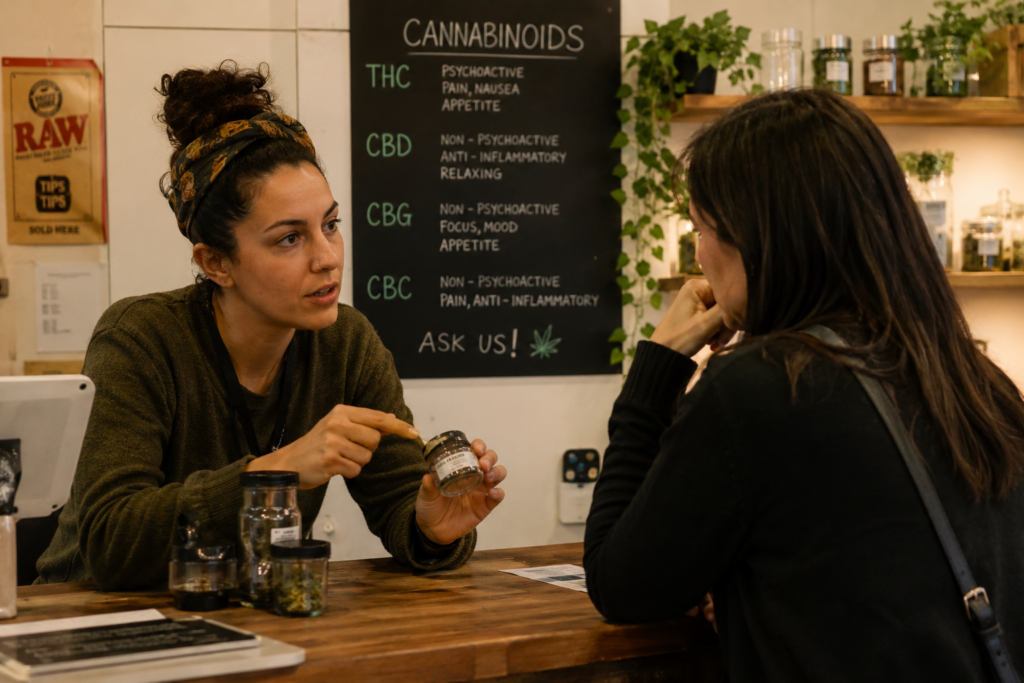
Many have developed considerable practical knowledge through lived experience, customer feedback, community learning, and years of observing how differently individuals respond to cannabinoid-based products. Some have become remarkably skilled at recognizing patterns and sensitivities that may not always be captured in formal research environments.
At the same time, the educational gap continues to be significant.
The Educational Gap in Cannabinoid Medicine
Most frontline cannabis workers were never fully trained to navigate:
- complex chronic illness
- medication interactions
- psychiatric vulnerability
- trauma histories
- cannabinoid pharmacology
- dosing variability
- ECS physiology
- inflammatory regulation
- the ethical line between education and medical advice
Yet they are asked to operate in this space every day.
This is not necessarily a failure of the people themselves.
In many ways, society normalized cannabis faster than it developed the educational, clinical, and public health infrastructure necessary to support its responsible use.
Patients increasingly seek advice, while clinicians are time-constrained, cautious, or, often, insufficiently trained in (endo)cannabinoid medicine. The result is that many conversations naturally migrate toward the people who are most accessible: frontline cannabis workers.
This places budtenders in a uniquely difficult position.
On one side, they may genuinely want to help reduce suffering. On the other hand, they routinely operate within systems heavily influenced by marketing language, product trends, anecdotal recommendations, THC percentages, customer reviews, and rapidly changing commercial pressures.
Moving Beyond Products Toward Physiology
Without an evidence-based educational foundation, the conversation can easily become product-centered rather than physiology-centered.
Questions become:
- “What strain should I use?”
- “What has the highest THC?”
- “What’s strongest?”
- “What works best?”
instead of:
- What symptoms are present?
- How reactive is the nervous system?
- What role does sleep or stress play?
- Are there medication interactions?
- Is this person highly sensitive to THC?
- Is inflammation involved?
- What are the treatment goals?
- Are there psychiatric or cardiovascular concerns?
- What does the evidence actually suggest?
This distinction matters.
Because cannabinoid medicine is not simply about products.
It is about regulation, variability, context, and physiology.
The same product may calm one person while increasing anxiety in another. One patient may experience meaningful pain relief, while another notices cognitive impairment or emotional blunting. Some individuals respond best to low doses. Others tolerate very little THC at all. Route of administration, terpene composition, dosing patterns, inflammatory state, trauma history, sleep quality, emotional regulation, age, metabolism, and medication interactions are all capable of influencing outcomes.
This is one reason the endocannabinoid system (ECS) has become increasingly important in these conversations.
The ECS is a widespread regulatory network involved in stress adaptation, immune signaling, pain modulation, sleep, emotional regulation, appetite, memory, interpersonal bonding, and homeostasis itself. Understanding even the basics of ECS physiology can begin shifting the conversation away from simplistic product recommendations and toward more individualized and informed approaches.
Importantly, this does not mean budtenders should become clinicians.
Nor does it mean cannabis is appropriate for every person or every condition.
But it does suggest that a shared educational foundation may greatly improve the quality of conversations across the entire ecosystem.
Building a Shared Educational Foundation
This is where patient-facing educational tools may become valuable.
When patients arrive with a more basic understanding of the ECS, individualized variability, safety considerations, dosing sensitivity, and evidence-informed treatment trends, conversations become more grounded and productive for everyone involved.
Patients often ask clearer and more meaningful questions.
Budtenders may feel less pressure to improvise beyond their training.
Clinicians can spend less time correcting misinformation and more time helping patients think critically about risks, benefits, and individualized care pathways.
In that sense, better educational infrastructure does not replace human discernment or judgment. It supports better discernment across the entire landscape.
This is part of the reason we have been working toward a simplified patient-facing educational platform built upon the much larger clinician-facing CannaKeys system. The more comprehensive clinical platform integrates human-curated scientific literature, emerging clinical findings, and real-world patient variability into a shared, evidence-informed framework to support clearer, more responsible decision-making.
Ultimately, most people throughout this ecosystem are trying to do the same thing.
Reduce suffering. Improve quality of life. And make more informed choices in an area where uncertainty, complexity, and rapid cultural change continue to collide.
In the next piece (Part 5), I’ll explore how the ECS may serve as a shared language that helps patients, clinicians, and frontline cannabis workers navigate this complexity together.
Next in the Series:
Part 1 (in case you missed it): A Changing Landscape in Health and Healing
Part 2 (in case you missed it): Why So Many Patients Feel Lost in Cannabinoid Medicine
Part 3: (in case you missed it): Why So Many Clinicians Are Curious—Yet Still Hesitant
Part 5: The ECS as a Shared Language for Patients, Clinicians, and Purveyors
Part 6: Why We Built a Patient-Facing ECS Platform